

Ah, the cellphone! That little magical object that seems to possess a supernatural power in the art of distracting even the most steadfast canine trainers. Have you ever felt that, in the midst of an intense training session with your faithful four-legged companion, that innocent device becomes an irresistible magnet for your attention? The concentration you’ve worked so hard to cultivate fades away in the blink of an eye, leaving you ensnared in the digital abyss while your dog looks at you patiently, wondering if it’s been relegated to a supporting role in the story of your life.
But fear not, dear trainer. In this article, we will not only explore the cunning ability of the cellphone to overshadow even the most obedient canine but also unveil strategies to reclaim your lost focus and keep this modern threat at bay. Because we understand that while technology brings us a world of information and entertainment at our fingertips, we can’t allow it to become the number one enemy of our training sessions.
We’ll delve into the fascinating paradox that the cellphone represents: a tool that’s meant to connect us to the world, yet often disconnects us from what truly matters. We’ll explore how, in the blink of an eye, we can go from giving firm commands to Fido to mindlessly scrolling through the endless stream of online content. But all is not lost, for alongside understanding how we fall into the distraction trap, we’ll also share practical tips to overcome it and regain those precious moments of focus.
So gear up, brave canine trainer, to discover how to challenge the master of distraction, that little device attempting to snatch away your time and connection with your loyal companion. In the upcoming sections, we’ll equip you with the tools and insights needed to confront this challenge and triumph in the battle to keep the number one public enemy of canine training at bay: the dreaded cellphone!

When the Partner Takes a Backseat
Canine training, as elucidated in prior articles, demands an unwavering sense of focus and attention. Yet, the modern world’s insidious contender for our attention—our trusty cellphone—slyly sneaks its way into the spotlight, often at the expense of our faithful furry companions.
In a realm where precise commands and a keen understanding of your dog’s behavior are paramount, any deviation from this all-encompassing focus can be detrimental. Picture this: you’re working with your canine protégé on a new trick, and just as you’re about to make a breakthrough, a notification chimes in. Your attention wavers, your dog’s eager eyes turn quizzical, and the magic of the moment dissipates.
Research into human attention spans and cognitive focus reveals that even seemingly minor distractions, such as the allure of a buzzing smartphone, wield the power to derail our concentration. Notifications dance across the screen, beckoning us away from the present moment, while our steadfast companions sit patiently, perhaps questioning their place in our shifting priorities.
Moreover, the habit of answering messages or indulging in a quick call transforms the training session into a fragmented experience. We lose ourselves in the digital realm, and when we finally resurface, it takes a staggering 30 minutes, as indicated by scientific studies, to regain our cognitive footing.
It’s essential to recognize that during those critical minutes of divided attention, the potential for effective training diminishes, leaving both you and your dog shortchanged. This leads us to question: is our cell phone truly enhancing our lives or inadvertently demoting our loyal partners to mere background props?
As we navigate this technological age, understanding the profound implications of distracted training becomes increasingly crucial. It’s not just about dog training; it’s about strengthening our connections, both with our four-legged companions and with ourselves. In the following sections, we’ll delve into the science behind focus and delve into authoritative scientific references that illuminate the challenging path to reclaiming our attention from the clutches of the digital realm.

The Allure and Withdrawal: Smartphone Induction and True Cravings
In an era dominated by the digital age, the smartphone has risen to unparalleled prominence, entwining itself seamlessly into the fabric of our daily lives. But what exactly fuels this magnetic attraction, and can its grip on our attention transform into something akin to withdrawal symptoms?
The Seductive Allure: Pulling us In
The modern smartphone isn’t just a device; it’s an extension of ourselves. The allure it wields is born from the way it meets our deepest psychological needs. Social media platforms, designed to capitalize on our desire for connection and affirmation, dangle likes, comments, and shares like digital rewards. Notifications deliver a hit of dopamine—an ancient neurotransmitter associated with pleasure—making every beep or buzz a momentary thrill. This operant conditioning, reminiscent of classical Pavlovian psychology, encourages us to check our phones compulsively, often at the cost of real-world interactions.
Apps are meticulously designed to be intuitive and engaging. Endless scrolling, autoplay videos, and infinite feeds foster a sense of continuity, making it challenging to disengage. With every flick and swipe, the brain craves the unpredictable rewards lying just around the digital corner. This cycle of engagement and instant gratification draws us in, further embedding the smartphone’s place in our lives.
The Digital Disconnect: A Glimpse of Withdrawal
Ironically, a tool meant to connect us can also leave us feeling isolated when it’s absent. The feeling of “nomophobia,” or the fear of being without one’s phone, is a testament to this dependency. The digital world becomes a comfort zone, and venturing beyond its confines can lead to feelings of unease and disconnection.
Research has begun to uncover the spectrum of symptoms that mirror substance addiction. Pervasive use of smartphones, especially before bed, has been shown to disrupt sleep patterns, leading to irritability and impaired cognitive function. The rise of “technoference” has brought to light the frustration and feelings of rejection experienced when a loved one prioritizes their device over meaningful interactions.
From Allure to Ache: The Emergence of True Cravings
But can our digital attachment truly transform into full-fledged withdrawal symptoms? A growing body of evidence suggests so. The phenomenon known as “digital detox” illustrates how periods of intentional disconnection can lead to symptoms reminiscent of substance withdrawal. Feelings of anxiety, restlessness, and even physical discomfort can emerge.
The “phantom vibration syndrome” is another eerie revelation. Our brains have become so attuned to the vibration patterns of incoming notifications that we sometimes perceive vibrations even when the phone is silent. This highlights how deeply our cognitive and sensory systems have integrated the smartphone’s presence.
Navigating the Digital Abyss: Finding Balance
The smartphone’s allure is undeniable, but its potential to lead us down a path of dependency and withdrawal cannot be ignored. Striking a balance between technology and genuine human connection is imperative. Creating designated phone-free zones and setting digital boundaries can help mitigate the compulsion to engage.
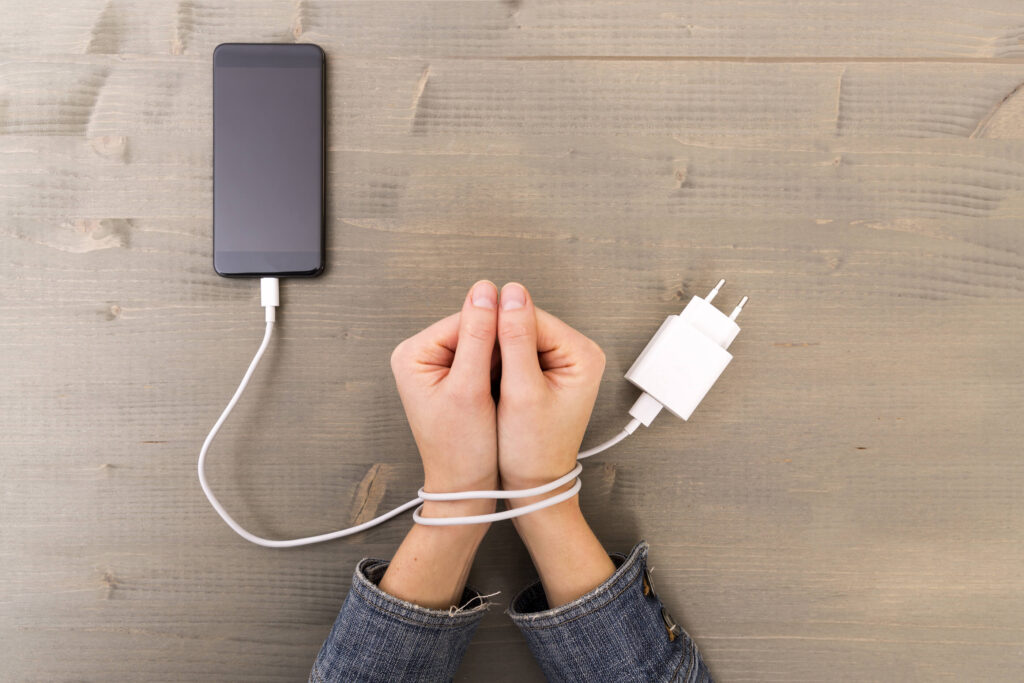
Breaking Free: Liberating Yourself from Smartphone Dependence in Canine Training
In the quest for effective canine training, conquering the allure of the smartphone and fostering a present-focused connection with your furry companion is paramount. But how do we navigate this digital labyrinth and reclaim our attention? Let’s delve into strategies backed by scientific insights to liberate ourselves from smartphone dependency and immerse ourselves fully in the training experience.
Unplugging for Genuine Connection
Psychological research underscores the potential for smartphone dependency to undermine authentic interactions. Dr. Sherry Turkle, a renowned psychologist and author, delves into this in her book “Reclaiming Conversation.” She emphasizes the importance of face-to-face interactions, advocating for moments of digital detox to nurture deeper connections. Incorporating these moments of intentional disconnection into your training routine can facilitate a richer partnership with your dog.
Taming the Notifications: A Science-Backed Approach
Research from the University of California, Irvine, sheds light on the true cost of notifications. A study led by Gloria Mark, a professor in informatics, found that it takes an average of 23 minutes and 15 seconds to return to a task after an interruption. Turning off non-essential notifications during training sessions can help mitigate these interruptions, allowing for sustained focus. A strategic approach to notifications, inspired by these findings, can significantly enhance the quality of your training interactions.
Embracing Mindfulness in Training
Mindfulness, a practice rooted in Buddhist philosophy and corroborated by scientific research, offers an antidote to the digital haze. Dr. Jon Kabat-Zinn, a pioneer in mindfulness-based stress reduction, explains that mindfulness involves paying attention to the present moment non-judgmentally. Applying this principle to canine training means immersing yourself fully in the experience—observing your dog’s responses, noting your own reactions, and fine-tuning your training techniques.
Implementing a Digital “Leash”: Real-World Examples
Tech luminaries are recognizing the need to curtail digital addiction. Tristan Harris, a former Google design ethicist, co-founded the Center for Humane Technology to advocate for technology that aligns with human values. Inspired by Harris’ work, consider adopting strategies like using grayscale mode on your phone, which reduces the visual appeal of apps and notifications, making it less tempting to engage mindlessly.
Present-Centric Training: A Holistic Approach
Drawing inspiration from psychology and mindfulness practices, integrate these strategies into your training routine. Set designated training times devoid of smartphone interruptions. Silence notifications and even experiment with leaving the phone in another room. Embrace the art of undivided attention, focusing solely on your dog’s cues, responses, and progress.
The liberation from cellphone dependency is a serious and significant aspect, even for the profession of a dog trainer and handler. It’s not to be underestimated in any way, and it’s best to start from a common principle: we all suffer from it, and the sooner we realize it, the sooner we will be able to free ourselves!


Un commento